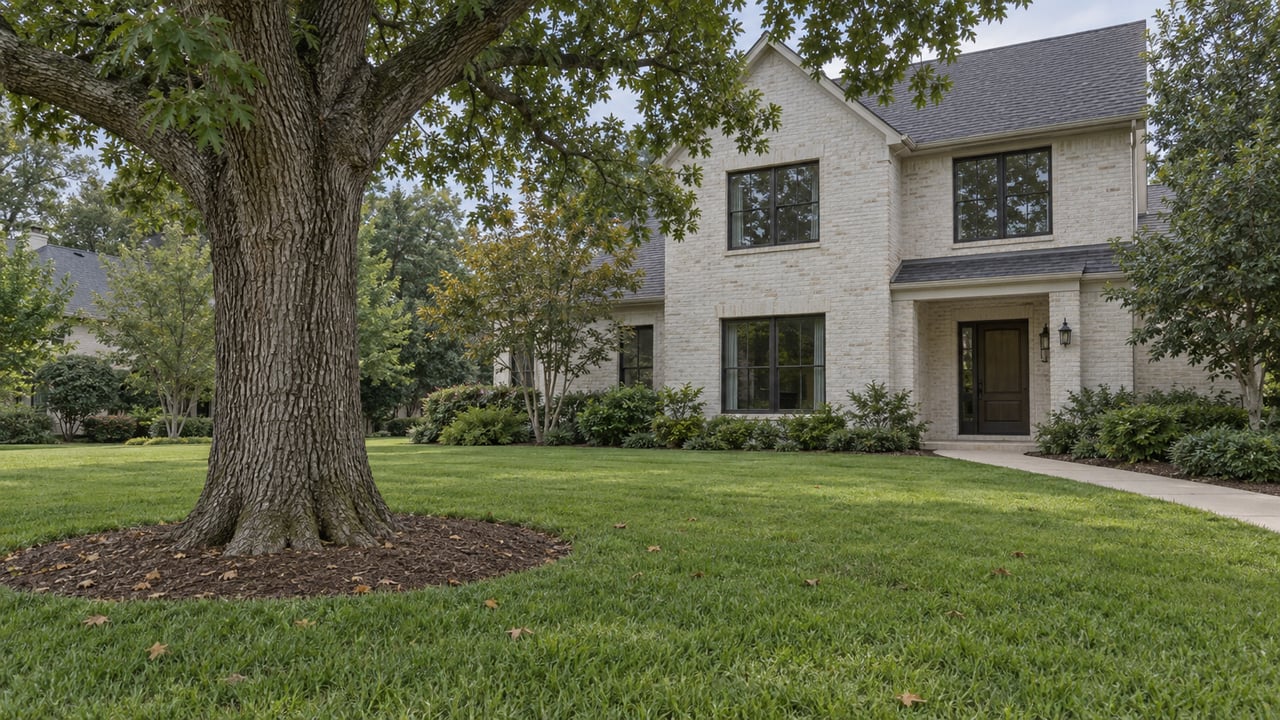
At an April 2026 City Council work session, GIS Manager Bridget Lawlor delivered good news: citywide tree canopy had grown to 56.3 percent across 13,980 acres in 2025, up from 54.5 percent over 13,564 acres in 2023. Councilwoman Mary Ford's reaction, as reported by Appen Media, summed up how most residents would have guessed the number would move.
"I am surprised [by the 2 percent increase] because I feel like lots of trees are coming down."
She wasn't wrong about the removals. Construction near City Springs and the Solis Sandy Springs development by the MARTA station took a visible toll, and the I-285/GA-400 interchange rebuild alone erased close to 100 acres of canopy along the corridor between Mount Vernon Highway and the eastern city limits. Urban Forester Willie Park's explanation for why the citywide number still rose anyway is the detail that matters if you are buying, building, or selling a wooded lot here: much of what gets cleared on a construction site is thin "edge" growth that barely registers on a canopy map, while the hardwoods behind it get room to spread once the crowding disappears.
That gap between what a homeowner sees (a bulldozer, a pile of logs, a bare lot) and what the ordinance actually measures is where buyers and sellers get surprised. And the biggest source of that surprise isn't the trees on the property. It's the ones next door.
The Boundary Tree Nobody Budgets For
Sandy Springs' Tree Conservation Ordinance sorts trees into tiers, and the tier that catches people off guard is the Boundary Tree: a tree 10 inches in diameter at breast height or larger that sits on an adjacent property, not the one being built on. That threshold used to be 18 inches. The city council lowered it to 10 inches in a 2015 ordinance revision specifically to extend protection to more of a neighbor's canopy, according to reporting at the time from Patch.
The practical effect: a tree you don't own, can't remove, and never planned to touch can still constrain how close to a property line you're allowed to grade, trench, or stage equipment, because the city has to determine whether your construction activity deprives that neighbor's tree of the room it needs to survive. If the City Arborist decides the answer is uncertain, the property owner next door gets formal notice before your permit is issued. On a tight infill lot along Northside Drive or in the older subdivisions off Heards Ferry Road, that single tier of the ordinance can move a foundation footprint by feet you didn't plan to give up.
Root Zones Don't Care Where the Chainsaw Starts
The second friction point shows up after the permit is approved, when the equipment arrives. Sandy Springs measures tree damage by Critical Root Zone, not by whether a saw touched the trunk. The city's own Landscape, Tree and Buffer submittal standards state that a tree suffering disturbance to 25 percent of its CRZ is generally considered destroyed, whether or not anyone intended to remove it.
That standard matters most on the kind of tight, tree-heavy lots that make up much of Riverside, Powers Ferry, and the older streets branching off Roswell Road. A grading contractor who compacts soil or cuts roots while maneuvering equipment near a tree that was never on the removal list can trigger the same replacement and Tree Fund obligations as if the tree had been felled on purpose. Buyers who assume the trees marked "keep" on a site plan are automatically safe are often the ones who get an unpleasant call from the arborist's office mid-build.
What Counts as What
The tiers stack, and the required response changes depending on which one applies.
| Tier | Threshold | Where it applies | What removal requires |
|---|---|---|---|
| Protected Tree | 18" DBH hardwood or pine, fair condition or better | Anywhere on the property | Permit; contributes 1,000 sq ft canopy credit |
| Landmark Tree | Hardwood 27"+ DBH, pine 30"+ DBH, dogwood/redbud 10"+ DBH | Anywhere on the property | Permit; replacement at 150% of lost canopy |
| Boundary Tree | 10" DBH or larger | On an adjacent property | City review of whether construction threatens viability; neighbor notice |
| Setback Tree | 18" DBH or larger | Within required setbacks | Arborist weighs preservation factors before approving removal |
A lot can carry all four tiers at once, which is why a walk-through with an arborist before closing tells you more than a listing photo ever will.
The Math Behind One Rebuild
The city's own technical manual walks through a worked example that's worth doing on any lot before you write an offer. On a 34,189 square foot site, the 35 percent residential canopy minimum works out to a required 11,966 square feet of canopy coverage. Since each Protected Tree only credits 1,000 square feet toward that number, a lot needs roughly a dozen qualifying trees standing, or replaced, to clear that bar on its own.
Fall short, and the cost isn't abstract. The city's Tree Removal Permits page lists a $1,200 payment into the City Tree Fund for each Protected Tree removed that pushes a property below minimum canopy, on top of a required replacement planting for that same tree. Take down a Landmark Tree and the replacement obligation jumps to 150 percent of its lost canopy, calculated on actual measured square footage rather than a flat credit. On a full teardown where a builder is clearing most of a wooded quarter-acre to build a larger footprint, those payments add up fast enough to change a renovation budget, and they're rarely itemized on the builder's initial estimate.
An Older Story, Same Gap
Nearly a decade ago, a resident on Dudley Lane watched two long-vacant wooded lots next door head toward redevelopment, including a tree believed to be around 150 years old sitting in the back corner. When he raised the issue with the city, according to 11Alive's coverage at the time, a city spokesperson noted the tree sat on private property. The resident's frustration, as he put it to the station, was that Sandy Springs doesn't protect specimen trees the way the city of Atlanta does for trees of similar age and size.
The specifics of that case are dated, but the mechanism it illustrates hasn't changed. Age and size alone don't grant protection. A tree earns a tier based on measured DBH and location, not sentiment or history, and a tree that misses every threshold can legally come down even if it predates the subdivision around it. If you are buying a home specifically because of a mature tree canopy, the ordinance won't guarantee that any single tree survives the next owner's plans unless it happens to clear the Protected, Landmark, Boundary, or Setback definitions.
What the City's Own Numbers Say
The 2025 survey result is worth sitting with for a second reason beyond the councilwoman's surprise. A nonprofit tracking the ordinance, Environment Sandy Springs, has argued that the city has never formally analyzed whether redeveloped properties actually hit the 35 percent target once the tree-fund-in-lieu option is used, and suggests the real number on rebuilt lots likely runs lower than the citywide figure implies. Read alongside Park's edge-tree explanation, the picture that emerges is a canopy measurement built mostly from large-scale patterns (an interchange rebuild, a mixed-use corridor) rather than from what happens lot by lot on a residential teardown. A buyer evaluating one specific wooded parcel is looking at a much narrower, harder-to-predict outcome than the citywide trend line suggests.
Before You Write the Offer or List the Lot
A few checks are worth doing before either side signs anything:
- Ask for a current DBH count on any tree near the property line, not just trees on the lot itself, since Boundary Tree status depends on the neighbor's tree, not yours
- Confirm whether a Tree Conservation Plan has already been filed with the city if construction, grading, or a pool is planned, since a standalone Tree Removal Permit isn't the right form once construction is involved
- Check whether the neighborhood has an active HOA design review board, since HOA approval does not substitute for a city permit and the city's approval doesn't override HOA covenants either
- Run the canopy math yourself using the 35 percent minimum and 1,000 square foot per Protected Tree credit before assuming a heavily wooded lot has room to clear for a larger footprint
A Few Questions That Come Up
Does removing a dead or hazardous tree still require a permit? No, but the city requires notification to the arborist's office with photo documentation or a report confirming the dead, dying, or hazardous condition before removal.
Can a certificate of occupancy get held up over tree compliance? Yes. City code specifies that a certificate of occupancy will not be issued on a property where tree conservation obligations under the ordinance haven't been satisfied.
If my neighbor's tree limits my building envelope, do I have any recourse? The ordinance directs the City Arborist to weigh viability factors and, in cases of uncertainty, to notify the neighboring property owner before a permit is issued. That process runs through the city, not through a private negotiation between owners.
A wooded lot in Sandy Springs is rarely a simple asset to price. The canopy that makes a property appealing on a listing photo is also a set of obligations that follow the next closing, and the ones that catch people off guard are almost never the ones the seller planned to remove. If you're weighing a teardown, an infill build, or a listing on a heavily treed lot anywhere from Riverside to the Mount Vernon corridor, Rhonda Shell Real Estate can walk the property with you before you write an offer or a listing agreement. Request a complimentary market analysis and we'll flag what the canopy math actually says about your specific lot.